RECOGNITION SIGNALS (WHEN TO USE THIS PATTERN)
✓Traverse or search a binary tree or BST
✓Compute height, depth, diameter, or path sum
✓Validate BST property or balance condition
✓Find the lowest common ancestor of two nodes
✓Serialize / deserialize a tree structure
✓Level-order processing — row by row
1
Types of Problems (Subpatterns)
Each subpattern solves a specific type of problem. Click on a card to view its template.
✓ SELECTED
DFS — Recursive Traversal
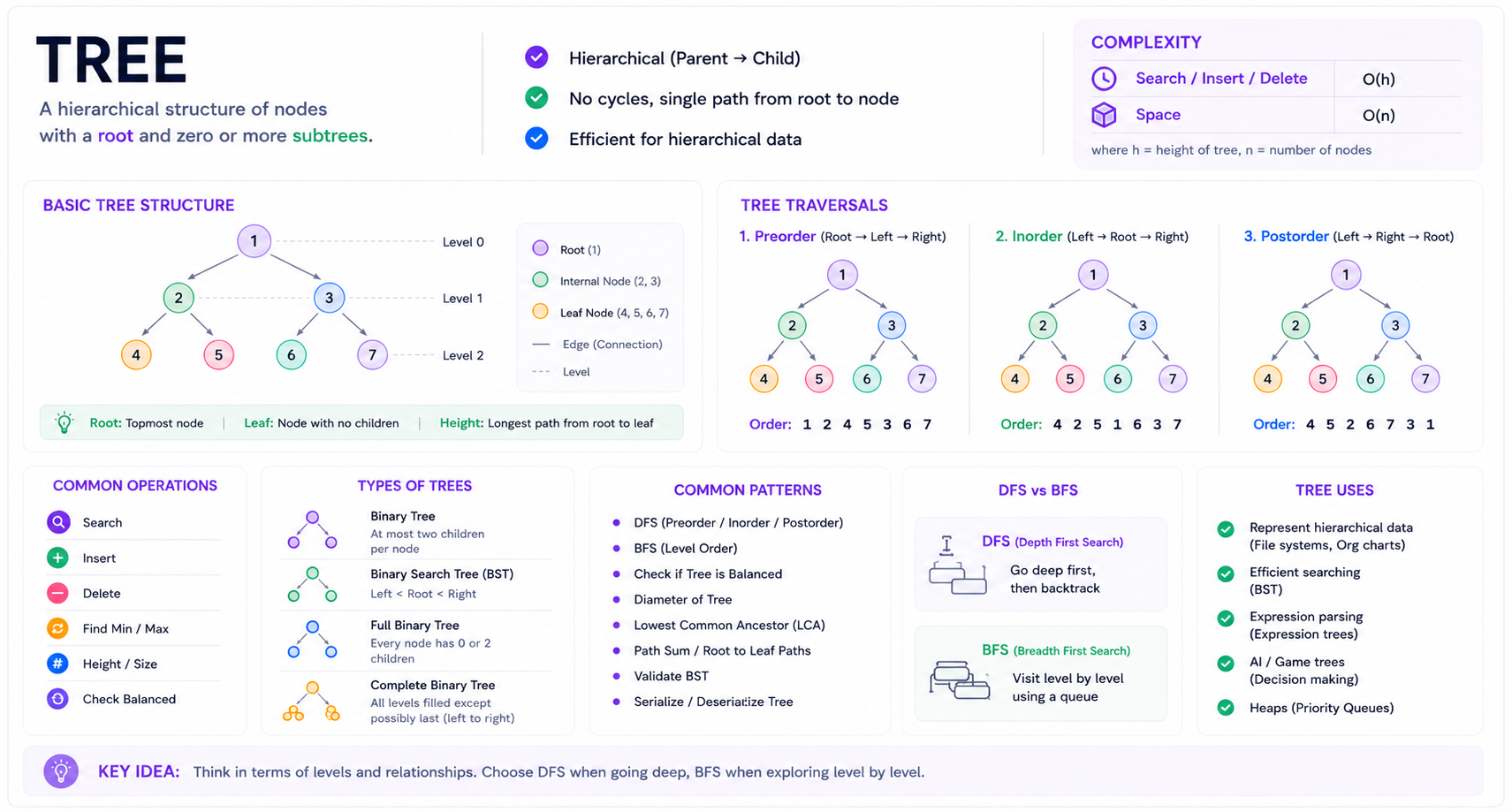
Pre / In / Post-order — choose the order based on when you need the parent vs children.
- Binary Tree Inorder Traversal
- Maximum Depth of Binary Tree
- Path Sum
5 problems
BFS — Level-Order Traversal
Use a queue to process the tree row by row — ideal for level-specific questions.
- Binary Tree Level Order Traversal
- Binary Tree Right Side View
- Average of Levels in Binary Tree
5 problems
Binary Search Tree Operations
Exploit BST ordering: left < node < right to search, insert, and validate in O(H).
- Validate Binary Search Tree
- Kth Smallest Element in a BST
- Lowest Common Ancestor of a BST
5 problems
Lowest Common Ancestor
Post-order DFS: the LCA is the first node that finds both targets in different subtrees.
- Lowest Common Ancestor of a Binary Tree
- Lowest Common Ancestor of a BST
- Lowest Common Ancestor of Deepest Leaves
5 problems
Tree Construction & Serialization
Rebuild a tree from traversal arrays or encode/decode it to a flat string.
- Construct Binary Tree from Preorder and Inorder
- Construct Binary Tree from Inorder and Postorder
- Serialize and Deserialize Binary Tree
5 problems
Path Sum & Tree DP
Compute optimal values over all root-to-leaf or node-to-node paths with post-order DP.
- Binary Tree Maximum Path Sum
- Path Sum III
- Sum Root to Leaf Numbers
5 problems
Iterative DFS (Explicit Stack)
Replace recursion with an explicit stack — required when recursion depth exceeds the call-stack limit.
- Binary Tree Inorder Traversal (iterative)
- Binary Tree Preorder Traversal (iterative)
- Binary Tree Postorder Traversal (iterative)
5 problems
2
Template / Approach
Template for: DFS — Recursive Traversal
Approach
Template
</>Common Template
💡Universal DFS skeleton. Place your logic before (pre-order), between (in-order), or after (post-order) the recursive calls depending on whether you need the parent before or after its children.
🔑
Key Idea:Trust the recursive contract: if dfs(left) and dfs(right) both return the correct answer for their subtrees, combining them at the current node is all that's needed. The base case (nullptr) provides the identity element (0 for height, true for balance, etc.).
1// DFS skeleton — adapt order as needed2void dfs(TreeNode* node)3{4 if (!node) return; // base case56 // PRE-ORDER: process node BEFORE children7 process(node);89 dfs(node->left);10 dfs(node->right);1112 // POST-ORDER: process node AFTER children13 // process(node);14}1516// ── returning a value (e.g. height) ─────────────17int height(TreeNode* node)18{19 if (!node) return 0;2021 int leftH = height(node->left);22 int rightH = height(node->right);2324 return 1 + max(leftH, rightH); // combine25}
Easy
Maximum Depth of Binary Tree
LeetCode #104
Easy
Invert Binary Tree
LeetCode #226
Easy
Diameter of Binary Tree
LeetCode #543
Easy
Path Sum
LeetCode #112
Easy
Balanced Binary Tree
LeetCode #110
Easy
Symmetric Tree
LeetCode #101
Medium
Binary Tree Level Order Traversal
LeetCode #102
Medium
Binary Tree Right Side View
LeetCode #199
Easy
Average of Levels in Binary Tree
LeetCode #637
Medium
Binary Tree Zigzag Level Order Traversal
LeetCode #103
Medium
Maximum Width of Binary Tree
LeetCode #662
Medium
Validate Binary Search Tree
LeetCode #98
Medium
Kth Smallest Element in a BST
LeetCode #230
Medium
Lowest Common Ancestor of a BST
LeetCode #235
Medium
Delete Node in a BST
LeetCode #450
Medium
Lowest Common Ancestor of a Binary Tree
LeetCode #236
Medium
Lowest Common Ancestor of Deepest Leaves
LeetCode #1123
Medium
Maximum Difference Between Node and Ancestor
LeetCode #1026
Medium
Construct Binary Tree from Preorder and Inorder Traversal
LeetCode #105
Hard
Serialize and Deserialize Binary Tree
LeetCode #297
Easy
Convert Sorted Array to Binary Search Tree
LeetCode #108
Medium
Flatten Binary Tree to Linked List
LeetCode #114
Hard
Binary Tree Maximum Path Sum
LeetCode #124
Medium
Path Sum III
LeetCode #437
Medium
Sum Root to Leaf Numbers
LeetCode #129
Medium
House Robber III
LeetCode #337
Easy
Binary Tree Inorder Traversal
LeetCode #94
Easy
Binary Tree Preorder Traversal
LeetCode #144
Medium
Recover Binary Search Tree
LeetCode #99