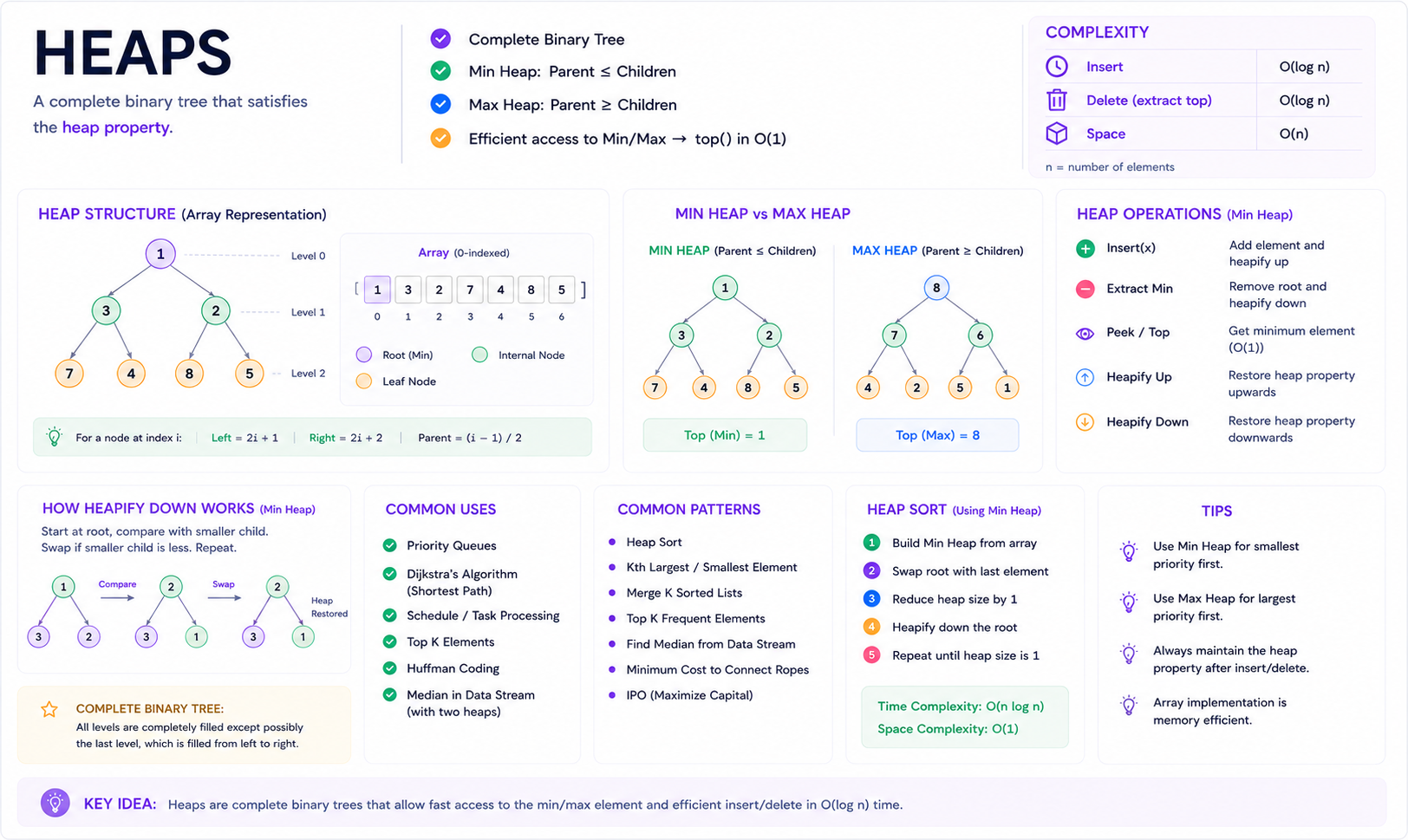
RECOGNITION SIGNALS (WHEN TO USE THIS PATTERN)
✓Find or maintain the k-th largest / smallest element
✓Repeatedly extract the minimum or maximum from a dynamic set
✓Schedule tasks or merge streams by priority
✓Merge k sorted arrays or lists efficiently
✓Sliding window maximum or minimum
✓Two-heap split to maintain a running median
1
Types of Problems (Subpatterns)
Each subpattern solves a specific type of problem. Click on a card to view its template.
✓ SELECTED
Top-K Elements
Maintain a heap of size k — evict the worst element whenever the heap overflows.
- Kth Largest Element in an Array
- Top K Frequent Elements
- K Closest Points to Origin
5 problems
K-Way Merge
Seed a min-heap with the head of each sorted list; always pop the global minimum and push its successor.
- Merge K Sorted Lists
- Merge K Sorted Arrays
- Find K Pairs with Smallest Sums
5 problems
Running Median (Two Heaps)
Split the stream into two halves: a max-heap for the lower half and a min-heap for the upper half.
- Find Median from Data Stream
- Sliding Window Median
- IPO (maximize capital)
5 problems
Sliding Window Maximum
Use a monotonic deque — not a heap — to answer window max/min in O(N) total.
- Sliding Window Maximum
- Sliding Window Minimum
- Jump Game VI
5 problems
Task / Interval Scheduling
Sort by start time; use a min-heap to greedily assign or free resources.
- Task Scheduler
- Meeting Rooms II
- Minimum Number of Arrows to Burst Balloons
5 problems
Custom Comparator / Lazy Deletion
Custom comparators let you heap on any key; lazy deletion avoids O(N) removals.
- Find K Pairs with Smallest Sums
- Reorganize String
- Furthest Building You Can Reach
5 problems
2
Template / Approach
Template for: Top-K Elements
Approach
Template
</>Common Template
💡Top-k skeleton using a min-heap of size k. After all elements are processed, the heap holds the k largest elements and the root is the k-th largest. Flip to max-heap for k smallest.
🔑
Key Idea:A min-heap of size k is a filter: anything smaller than the current k-th largest gets evicted immediately. After N pushes and at most N pops, total cost is O(N log k) — much better than O(N log N) full sort when k << N.
1// Top-K Largest using a min-heap of size k2// Root = k-th largest; heap contains the k largest seen so far.3int findKthLargest(vector<int>& nums, int k)4{5 // min-heap: smallest of the top-k sits at the root6 priority_queue<int, vector<int>, greater<int>> minHeap;78 for (int x : nums)9 {10 minHeap.push(x);1112 if ((int)minHeap.size() > k)13 {14 minHeap.pop(); // evict the smallest — it's not in top-k15 }16 }1718 return minHeap.top(); // k-th largest19}
Medium
Kth Largest Element in an Array
LeetCode #215
Medium
Top K Frequent Elements
LeetCode #347
Medium
K Closest Points to Origin
LeetCode #973
Easy
Kth Largest Element in a Stream
LeetCode #703
Easy
The K Weakest Rows in a Matrix
LeetCode #1337
Hard
Merge K Sorted Lists
LeetCode #23
Medium
Kth Smallest Element in a Sorted Matrix
LeetCode #378
Hard
Smallest Range Covering Elements from K Lists
LeetCode #632
Medium
Find K Pairs with Smallest Sums
LeetCode #373
Hard
Find Median from Data Stream
LeetCode #295
Hard
Sliding Window Median
LeetCode #480
Hard
IPO
LeetCode #502
Hard
Sliding Window Maximum
LeetCode #239
Medium
Jump Game VI
LeetCode #1696
Hard
Constrained Subsequence Sum
LeetCode #1425
Medium
Meeting Rooms II
LeetCode #253
Medium
Task Scheduler
LeetCode #621
Medium
Car Pooling
LeetCode #1094
Medium
Minimum Number of Arrows to Burst Balloons
LeetCode #452
Medium
Furthest Building You Can Reach
LeetCode #1642
Medium
Reorganize String
LeetCode #767
Hard
Maximum Performance of a Team
LeetCode #1383
Medium
Process Tasks Using Servers
LeetCode #1882