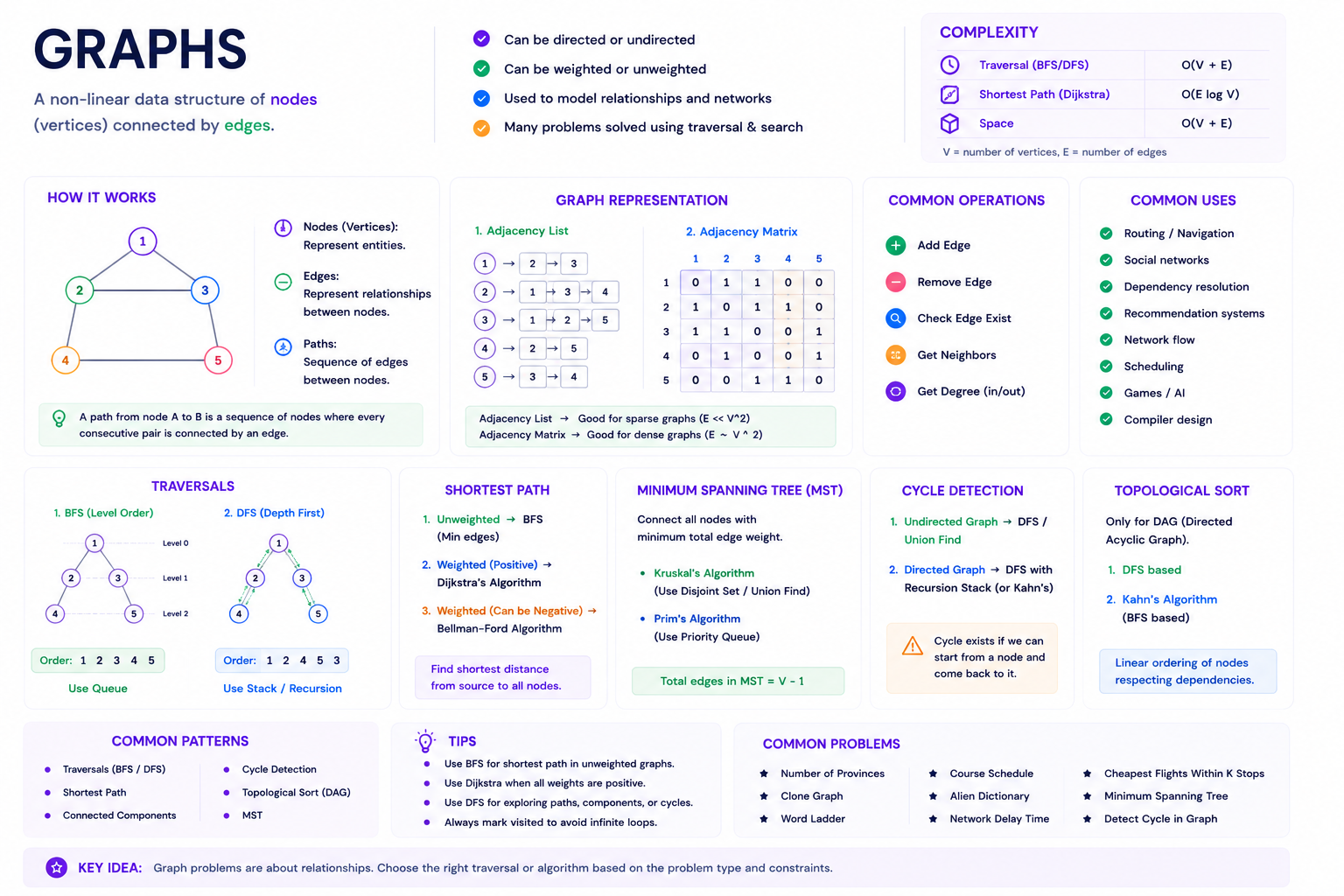
RECOGNITION SIGNALS (WHEN TO USE THIS PATTERN)
✓Islands, regions, or connected components in a grid or graph
✓Shortest path between two nodes (weighted or unweighted)
✓Detect a cycle in a directed or undirected graph
✓Topological ordering of tasks with dependencies
✓Union-Find / dynamic connectivity queries
✓Minimum spanning tree or network cost
1
Types of Problems (Subpatterns)
Each subpattern solves a specific type of problem. Click on a card to view its template.
✓ SELECTED
Graph DFS
Explore as deep as possible from each unvisited node — mark visited to avoid revisiting.
- Number of Islands
- Max Area of Island
- Clone Graph
5 problems
Graph BFS — Shortest Path
BFS explores layer by layer — the first time you reach a node is via the shortest path.
- Shortest Path in Binary Matrix
- Rotting Oranges
- Word Ladder
5 problems
Union-Find (DSU)
Track connected components dynamically — union in O(α) amortized with path compression + rank.
- Number of Connected Components in an Undirected Graph
- Redundant Connection
- Graph Valid Tree
5 problems
Topological Sort
Order nodes so all directed edges point forward — use Kahn's BFS or DFS post-order.
- Course Schedule
- Course Schedule II
- Alien Dictionary
5 problems
Dijkstra's Algorithm
Greedy shortest path for non-negative edge weights — min-heap drives expansion in order of distance.
- Network Delay Time
- Path With Minimum Effort
- Cheapest Flights Within K Stops
5 problems
Cycle Detection
Undirected: parent tracking. Directed: three-colour DFS (white/grey/black).
- Course Schedule (detect cycle in directed graph)
- Graph Valid Tree (undirected, no cycle)
- Redundant Connection
5 problems
Minimum Spanning Tree
Connect all nodes with minimum total edge weight — Kruskal (DSU) or Prim (heap).
- Minimum Cost to Connect All Points
- Min Cost to Connect Ropes
- Optimize Water Distribution in a Village
5 problems
2
Template / Approach
Template for: Graph DFS
Approach
Template
</>Common Template
💡Graph DFS skeleton for adjacency-list graphs. For grid DFS, replace the adjacency list with 4-directional neighbour generation and use (row, col) as the visited key.
🔑
Key Idea:Mark visited before recursing (not after) to handle cycles. For grids, sinking visited cells (setting to '0') avoids a separate visited array. For disconnected graphs, always loop over all nodes and call DFS on each unvisited one.
1// Graph DFS — adjacency list, O(V + E)2vector<vector<int>> adj; // adj[u] = list of neighbours of u3vector<bool> visited;45void dfs(int node)6{7 visited[node] = true;89 for (int neighbour : adj[node])10 {11 if (!visited[neighbour])12 {13 dfs(neighbour);14 }15 }16}1718// Call for every unvisited node to handle disconnected components19int countComponents(int n)20{21 adj.assign(n, {});22 visited.assign(n, false);23 int components = 0;2425 for (int i = 0; i < n; i++)26 {27 if (!visited[i])28 {29 dfs(i);30 components++;31 }32 }3334 return components;35}
Medium
Number of Islands
LeetCode #200
Medium
Max Area of Island
LeetCode #695
Medium
Clone Graph
LeetCode #133
Medium
Pacific Atlantic Water Flow
LeetCode #417
Medium
Surrounded Regions
LeetCode #130
Medium
Shortest Path in Binary Matrix
LeetCode #1091
Medium
Rotting Oranges
LeetCode #994
Hard
Word Ladder
LeetCode #127
Medium
01 Matrix
LeetCode #542
Medium
Jump Game III
LeetCode #1306
Medium
Number of Connected Components in an Undirected Graph
LeetCode #323
Medium
Redundant Connection
LeetCode #684
Medium
Graph Valid Tree
LeetCode #261
Medium
Accounts Merge
LeetCode #721
Medium
Course Schedule
LeetCode #207
Medium
Course Schedule II
LeetCode #210
Hard
Alien Dictionary
LeetCode #269
Medium
Minimum Height Trees
LeetCode #310
Medium
Network Delay Time
LeetCode #743
Medium
Path With Minimum Effort
LeetCode #1631
Medium
Cheapest Flights Within K Stops
LeetCode #787
Medium
Path With Maximum Probability
LeetCode #1514
Medium
Find Eventual Safe States
LeetCode #802
Medium
Detect Cycle in Directed Graph
LeetCode #207
Medium
Minimum Cost to Connect All Points
LeetCode #1584
Hard
Optimize Water Distribution in a Village
LeetCode #1168
Hard
Find Critical and Pseudo-Critical Edges in MST
LeetCode #1489