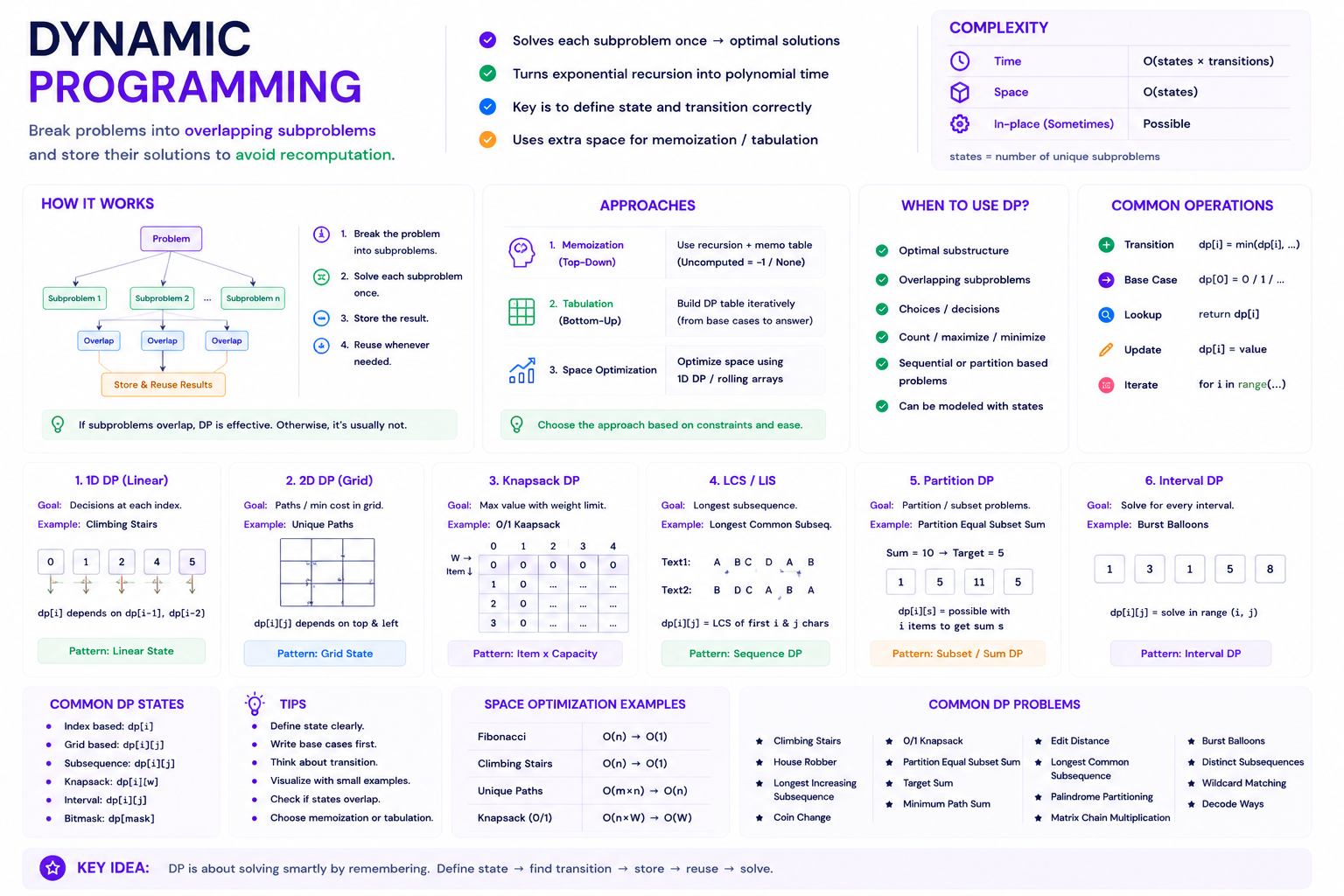
RECOGNITION SIGNALS (WHEN TO USE THIS PATTERN)
✓Optimal substructure present
✓Overlapping subproblems
✓Find min/max value or path
✓Count total number of ways
✓Decision at each index (pick/skip)
✓String alignment or matching
1
Types of Problems (Subpatterns)
Each subpattern solves a specific type of problem. Click on a card to view its template.
✓ SELECTED
1D DP & Linear Transitions
State depends on a constant number of previous elements (e.g., dp[i-1], dp[i-2]).
- Climbing Stairs
- House Robber
- Min Cost Climbing Stairs
5 problems
Knapsack & Subset Sum
Decide whether to include or exclude items to achieve a target weight or sum constraint.
- Partition Equal Subset Sum
- Coin Change
- Target Sum
5 problems
Longest Common Subsequence & String Alignment
Compare prefixes of two strings (size M and N) using a 2D grid.
- Longest Common Subsequence
- Edit Distance
- Longest Palindromic Subsequence
5 problems
Longest Increasing Subsequence & Decisions
Determine constraints on subsequences or maintain discrete state machine transitions.
- Longest Increasing Subsequence
- Best Time to Buy and Sell Stock with Cooldown
- Russian Doll Envelopes
5 problems
Grid / Path & Matrix DP
Traverse a 2D board with specific direction constraints (e.g., right/down).
- Unique Paths
- Minimum Path Sum
- Maximal Square
5 problems
2
Template / Approach
Template for: 1D DP & Linear Transitions
Approach
Template
</>Common Template
💡Standard 1D dynamic programming skeleton. This template tracks the last two states in variables to optimize space complexity from O(N) to O(1).
🔑
Key Idea:Linear 1D DP structures solve problems where subproblem dependencies represent chronological or sequential order. When transition accesses only a fixed distance in history, replace the DP array with rotating scalar variables to reduce auxiliary space to O(1).
1// 1D DP space-optimized to O(1)2int linearDP(int n)3{4 if (n <= 1) return n;56 int prev2 = 0; // state for dp[i-2]7 int prev1 = 1; // state for dp[i-1]8 int cur = 0; // state for dp[i]910 for (int i = 2; i <= n; i++)11 {12 // Example transition: dp[i] = dp[i-1] + dp[i-2]13 cur = prev1 + prev2;14 prev2 = prev1;15 prev1 = cur;16 }1718 return cur;19}
Easy
Climbing Stairs
LeetCode #70
Medium
House Robber
LeetCode #198
Easy
Min Cost Climbing Stairs
LeetCode #746
Medium
Decode Ways
LeetCode #91
Medium
Partition Equal Subset Sum
LeetCode #416
Medium
Coin Change
LeetCode #322
Medium
Target Sum
LeetCode #494
Medium
Coin Change II
LeetCode #518
Medium
Longest Common Subsequence
LeetCode #1143
Hard
Edit Distance
LeetCode #72
Medium
Longest Palindromic Subsequence
LeetCode #516
Medium
Longest Increasing Subsequence
LeetCode #300
Medium
Best Time to Buy and Sell Stock with Cooldown
LeetCode #309
Medium
Longest String Chain
LeetCode #1048
Medium
Unique Paths
LeetCode #62
Medium
Minimum Path Sum
LeetCode #64
Medium
Maximal Square
LeetCode #221