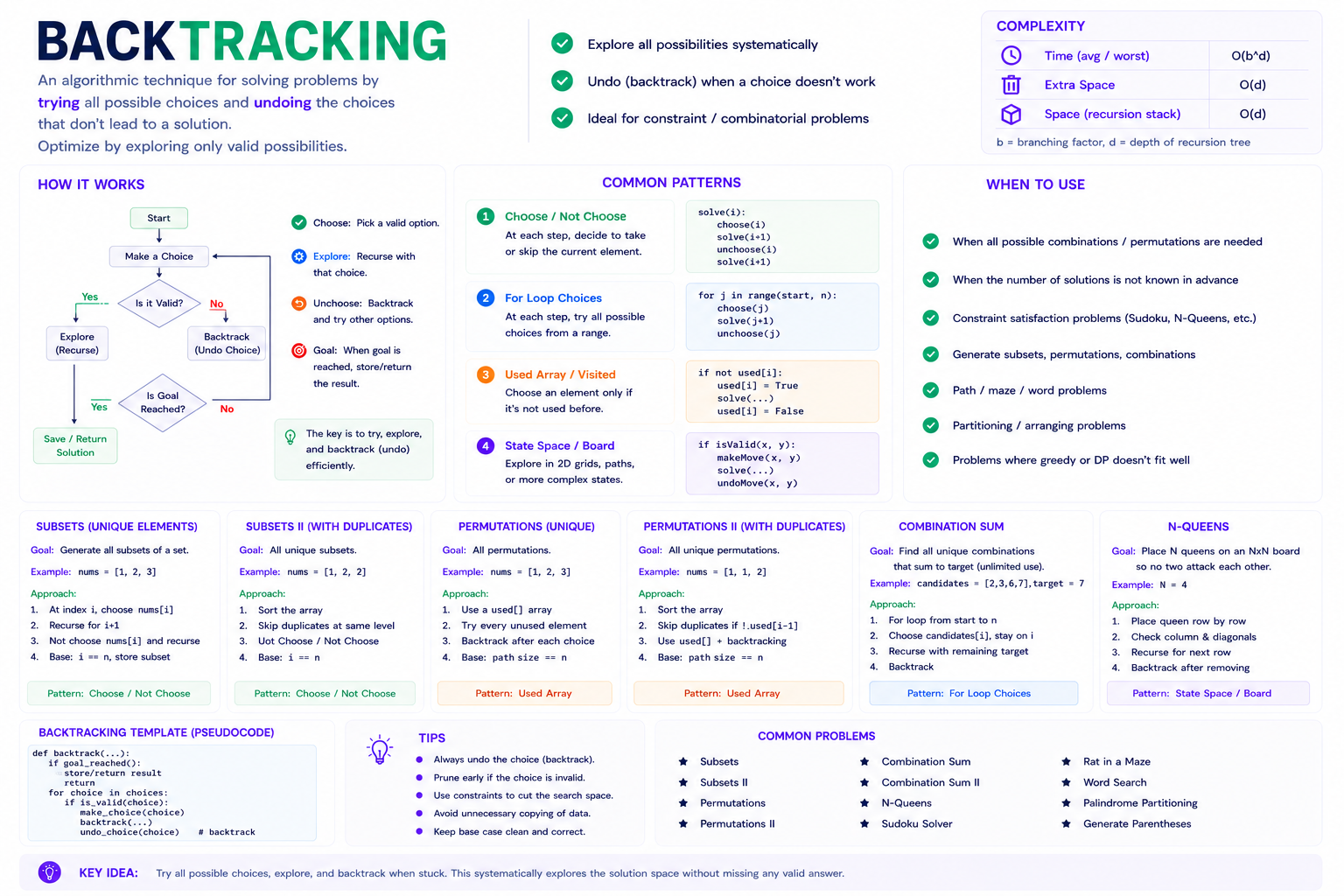
RECOGNITION SIGNALS (WHEN TO USE THIS PATTERN)
✓Generate all subsets, permutations, or combinations
✓Find all valid arrangements satisfying constraints
✓N-Queens, Sudoku, or grid path counting
✓Word search or sequence matching on a grid
✓Partition or split an input into valid segments
✓Return all solutions, not just one optimal value
1
Types of Problems (Subpatterns)
Each subpattern solves a specific type of problem. Click on a card to view its template.
✓ SELECTED
Subsets / Power Set
At each index, decide include or exclude — 2^N total subsets.
- Subsets
- Subsets II (with duplicates)
- Letter Case Permutation
5 problems
Combinations
Choose exactly k elements — prune branches that can't reach k early.
- Combinations
- Combination Sum
- Combination Sum II
5 problems
Permutations
Every ordering of elements — use a 'used' array to track which elements are in the current path.
- Permutations
- Permutations II (with duplicates)
- Next Permutation
5 problems
Grid / Word Search
DFS on a 2D grid — mark cells visited in-place, restore on backtrack.
- Word Search
- Word Search II
- Unique Paths III
5 problems
N-Queens / Constraint Placement
Place items row by row — use sets to check column and diagonal conflicts in O(1).
- N-Queens
- N-Queens II
- Sudoku Solver
5 problems
String Partition / Palindrome
Partition a string at every valid cut — prune immediately when the prefix is invalid.
- Palindrome Partitioning
- Restore IP Addresses
- Word Break II
5 problems
2
Template / Approach
Template for: Subsets / Power Set
Approach
Template
</>Common Template
💡Universal subset skeleton. Record result at every node (not just leaves) to capture subsets of every size. Pass start = i+1 to avoid reusing earlier elements.
🔑
Key Idea:Record the result at every recursion node (not just leaves) to capture all subset sizes. The 'start' index enforces a forward-only scan — no element is reused. For duplicates: sort first, then skip nums[i] == nums[i-1] when i > start (same level, not a child call).
1// Subsets — include/exclude at every index2vector<vector<int>> result;3vector<int> current;45void backtrack(vector<int>& nums, int start)6{7 result.push_back(current); // record subset at every node89 for (int i = start; i < (int)nums.size(); i++)10 {11 current.push_back(nums[i]); // choose12 backtrack(nums, i + 1); // explore (no reuse)13 current.pop_back(); // un-choose14 }15}1617vector<vector<int>> subsets(vector<int>& nums)18{19 backtrack(nums, 0);20 return result;21}
Medium
Subsets
LeetCode #78
Medium
Subsets II
LeetCode #90
Medium
Letter Case Permutation
LeetCode #784
Medium
Find All Subsets That Sum to Target
LeetCode #
Medium
Combinations
LeetCode #77
Medium
Combination Sum
LeetCode #39
Medium
Combination Sum II
LeetCode #40
Medium
Combination Sum III
LeetCode #216
Medium
Factor Combinations
LeetCode #254
Medium
Permutations
LeetCode #46
Medium
Permutations II
LeetCode #47
Hard
Permutation Sequence
LeetCode #60
Medium
Beautiful Arrangement
LeetCode #526
Medium
Word Search
LeetCode #79
Hard
Word Search II
LeetCode #212
Hard
Unique Paths III
LeetCode #980
Hard
Sudoku Solver
LeetCode #37
Hard
N-Queens
LeetCode #51
Hard
N-Queens II
LeetCode #52
Hard
24 Game
LeetCode #679
Medium
Palindrome Partitioning
LeetCode #131
Medium
Restore IP Addresses
LeetCode #93
Medium
Generate Parentheses
LeetCode #22
Hard
Word Break II
LeetCode #140
Hard
Palindrome Partitioning II
LeetCode #132