RECOGNITION SIGNALS (WHEN TO USE THIS PATTERN)
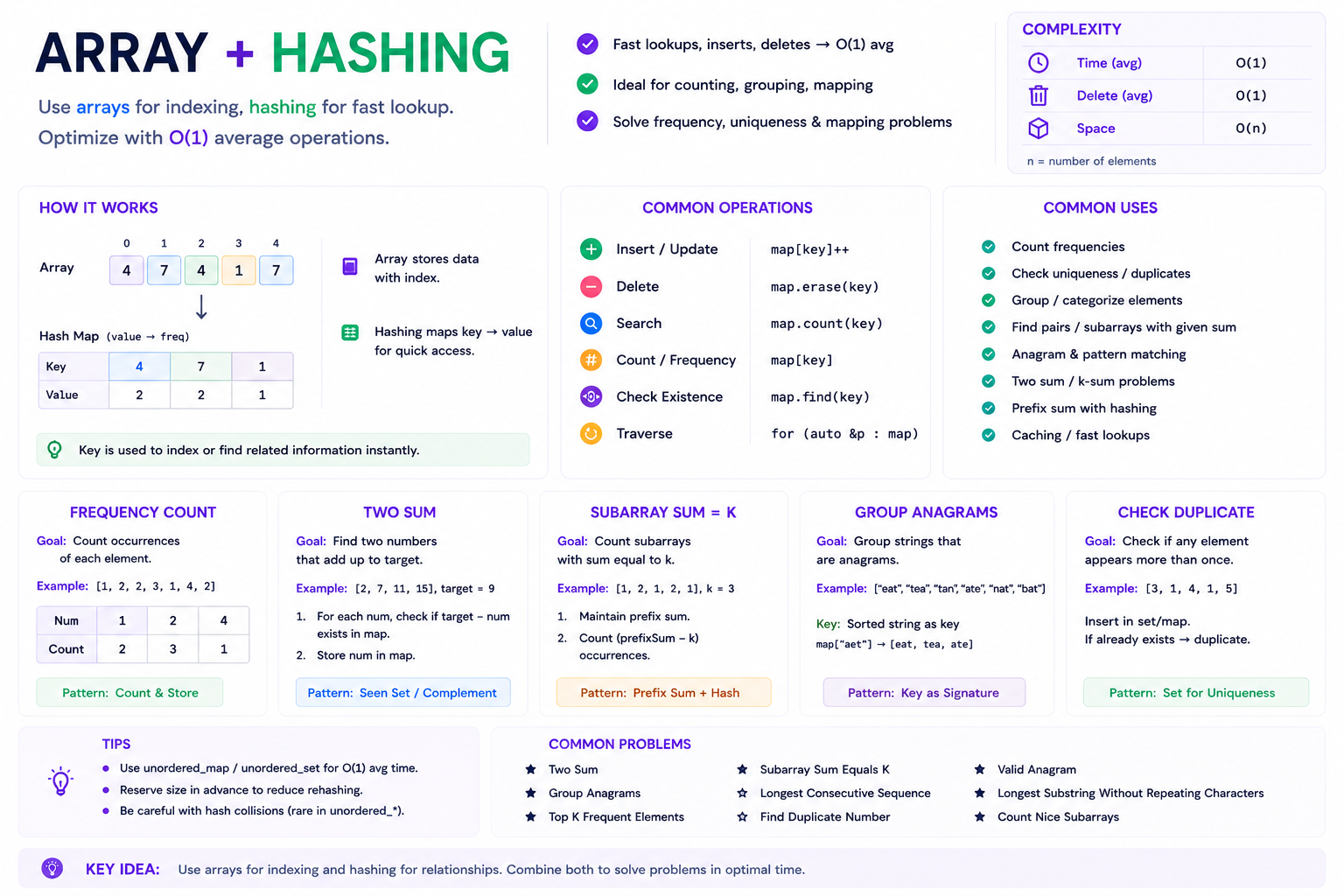
✓Count occurrences or frequencies
✓Need the index where something was previously seen
✓Only existence / membership check matters
✓Numbers are in the range 1…n (in-place marking possible)
✓Subarray sum, XOR, or modulo equals a target
✓Group or bucket elements by a shared property
1
Types of Problems (Subpatterns)
Each subpattern solves a specific type of problem. Click on a card to view its template.
✓ SELECTED
Frequency Counting
Count how many times each element appears, then query those counts.
- Valid Anagram
- Majority Element
- Top K Frequent Elements
5 problems
Index Mapping
Store where you saw a value so you can look it up in O(1) later.
- Two Sum
- Isomorphic Strings
- Word Pattern
5 problems
Set Lookup
Only existence matters — no counts, no positions.
- Contains Duplicate
- Longest Consecutive Sequence
- Happy Number
5 problems
In-place Marking
Use the array itself as the hash table — O(1) extra space.
- Missing Number
- Find All Numbers Disappeared in an Array
- Find All Duplicates in an Array
5 problems
Prefix Hashing
Hash the running prefix sum to find subarrays with a target sum in O(N).
- Subarray Sum Equals K
- Continuous Subarray Sum
- Contiguous Array
5 problems
Encoding / Hash Key
Convert complex objects into one canonical string key to bucket equivalents together.
- Group Anagrams
- Group Shifted Strings
- Design Underground System
5 problems
2
Template / Approach
Template for: Frequency Counting
Approach
Template
</>Common Template
💡Universal frequency-count skeleton. Build the map in one pass, then use the counts in a second pass or inline query.
🔑
Key Idea:Store Value → Count. Two passes are common: build frequency first, then use frequency. For fixed alphabets (26 chars) use a plain int array instead of a map.
1// ── Step 1: build frequency map ─────────────────2unordered_map<int, int> freq;34for (auto x : nums)5{6 freq[x]++;7}89// ── Step 2: query / process counts ──────────────10for (auto& [val, cnt] : freq)11{12 // val → element value13 // cnt → number of occurrences1415 if (cnt > 1) { /* duplicate */ }16 if (cnt == 1) { /* unique */ }17}
Easy
Valid Anagram
LeetCode #242
Easy
Ransom Note
LeetCode #383
Easy
Majority Element
LeetCode #169
Medium
Top K Frequent Elements
LeetCode #347
Medium
Sort Characters By Frequency
LeetCode #451
Easy
Two Sum
LeetCode #1
Easy
Isomorphic Strings
LeetCode #205
Easy
Word Pattern
LeetCode #290
Medium
Contiguous Array
LeetCode #525
Easy
Contains Duplicate
LeetCode #217
Easy
Happy Number
LeetCode #202
Medium
Longest Consecutive Sequence
LeetCode #128
Easy
Intersection of Two Arrays
LeetCode #349
Easy
Missing Number
LeetCode #268
Easy
Find All Numbers Disappeared in an Array
LeetCode #448
Medium
Find All Duplicates in an Array
LeetCode #442
Hard
First Missing Positive
LeetCode #41
Easy
Set Mismatch
LeetCode #645
Medium
Subarray Sum Equals K
LeetCode #560
Medium
Subarray Sums Divisible by K
LeetCode #974
Medium
Continuous Subarray Sum
LeetCode #523
Medium
Maximum Size Subarray Sum Equals k
LeetCode #325
Medium
Group Anagrams
LeetCode #49
Medium
Group Shifted Strings
LeetCode #249
Medium
Find Duplicate File in System
LeetCode #609